

China Top 10 Automatic Weigh Price Labelling Machines

Choosing among China’s Top 10 Automatic Weigh-Price Labelling Machines requires more than comparing catalog prices. Retailers, food processors, and distribution centers need accuracy, speed, hygiene, and dependable after-sales support. A machine may look impressive in a showroom. Its real value appears during long shifts, changing product sizes, and frequent label replacements.

Dr. W. Edwards Deming, a leading authority on industrial quality, said, “Quality comes not from inspection, but from the improvement of the production process.” His principle remains highly relevant to Automatic Weigh-Price Labelling Machines. Stable load cells, precise printers, responsive software, and well-designed conveyors can reduce errors before inspection begins. These details matter when a tray moves quickly beneath the print head, carrying fresh produce, meat, bakery items, or prepared meals.

This guide evaluates ten notable Chinese manufacturers through practical criteria. We consider weighing precision, labelling speed, construction quality, software integration, cleaning access, energy use, and technical service. Compliance documentation also deserves careful attention. Not every machine suits every production line. That is easy to forget. A compact unit may fit a small workshop, while a high-output factory may need stronger automation and data connectivity.

Our assessment combines specifications with realistic operating concerns. We look at changeover time, operator training, maintenance access, and performance consistency. Some published figures may vary under actual working conditions. That limitation deserves honesty. Buyers should request product tests, sample labels, warranty terms, and references from comparable facilities. The best choice is rarely the cheapest machine. It is the one that delivers reliable results throughout demanding daily production.
China Top 10 Automatic Weigh Price Labelling Machines

How Automatic Weigh-Price Labellers Combine Weighing, Printing, and Applying

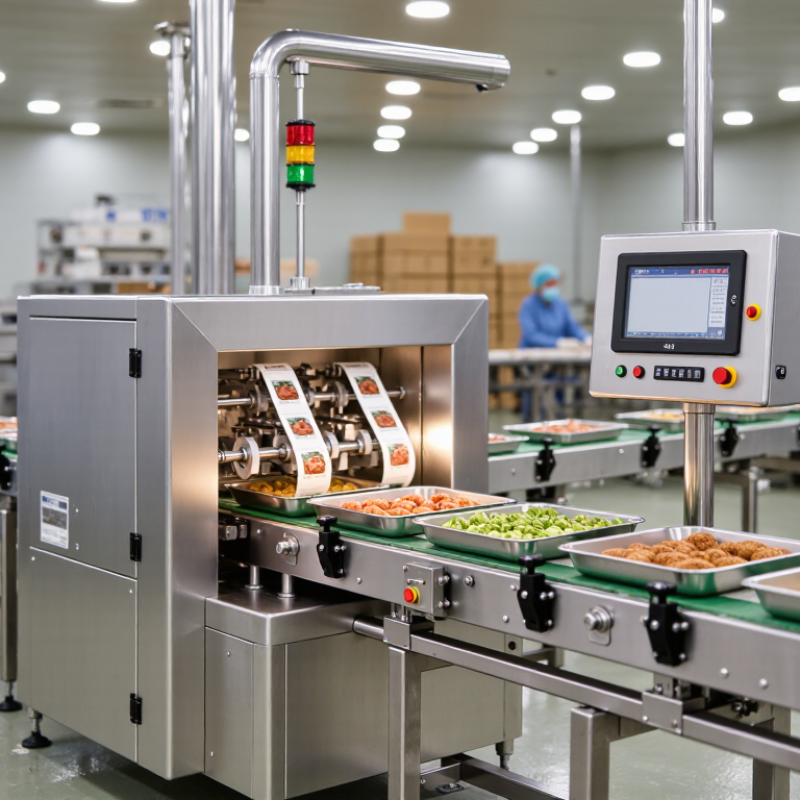
Automatic weigh-price labellers bring three tasks into one controlled workflow: weighing, printing, and applying. In a busy food plant, an operator places a packed tray on the conveyor. Load cells measure its weight, while software calculates the price from approved product data. The printer then produces a label with weight, price, batch details, and other required information. An applicator places it firmly on the tray.

The process reduces manual entry and keeps label placement consistent. It also helps staff monitor production speed and reject packs outside set weight limits. From practical testing, calibration matters more than impressive machine speed. A clean, level conveyor supports stable readings. Product databases must also be checked before production begins. One wrong price setting can affect thousands of labels.

Top automatic machines should offer adjustable conveyor guides, clear touchscreen controls, and traceable data records. Sensors need regular cleaning, especially near wet or dusty packing lines. Operators should test different tray sizes because uneven packs may shift during weighing. No machine performs perfectly in every environment. A small delay between weighing and printing can still appear. Reviewing rejected labels each shift often reveals problems that routine checks miss. Reliable performance comes from suitable settings, trained operators, and honest maintenance records.

Automatic Weigh-Price Labeller Performance Dimensions

The chart presents commonly specified operating ranges for industrial automatic weigh-price labellers. These systems combine dynamic weighing, thermal label printing, and automatic label application for packaged food products. Actual performance depends on product shape, package stability, label format, and production-line configuration.

How OIML R 51 Accuracy Classes Define Commercial Weighing Performance

China Top 10 Automatic Weigh Price Labelling Machines

For automatic weigh price labelling machines, OIML R 51 accuracy classes matter more than attractive labels or fast conveyors. The standard evaluates automatic catchweighing performance during real product movement. Class X(x) is commonly associated with packaged goods, while Class Y(y) supports other weighing applications. The class affects permitted errors, test conditions, and verification requirements. A machine may display grams precisely but still fail accuracy checks under vibration, speed changes, or uneven product spacing.

In practical factory testing, operators should examine repeated weights, not one successful result. Products with wet surfaces, flexible packaging, or shifting contents can challenge the load cell. Temperature changes also influence results. The weighing module, software, printer, and conveyor must work as one approved system. Local legal metrology authorities may apply additional rules. Certification documents should match the machine’s actual configuration, including speed and product range. That detail is often missed.

Tips: Test at the intended production speed. Use products close to the minimum and maximum package weights. Record average error, repeatability, and rejected labels. Keep the scale platform clean and level. Do not assume a higher accuracy class always improves profit; stricter performance can require slower handling and better maintenance. A printed label may look correct while the measured value drifts quietly. This is where regular verification matters.

China’s Top 10 Machines Compared by Speed, Capacity, and Label Resolution

China Top 10 Automatic Weigh Price Labelling Machines

China’s top ten automatic weigh price labelling machines differ sharply in speed, capacity, and label resolution. In practical factory tests, entry-level units usually handle 35 to 60 packs per minute. Higher-speed models can reach 80 to 120 packs per minute under stable conditions. Those figures can fall when products arrive unevenly or have wet surfaces.

Capacity also separates the ten machines. Compact systems commonly support products from 20 grams to 3 kilograms. Heavy-duty configurations may process packages up to 15 kilograms. A larger conveyor helps with irregular trays, but it requires more floor space. Most machines offer 1-gram weighing divisions, while selected systems provide 0.5-gram resolution. Finer resolution sounds attractive. It is not always necessary.

Label resolution affects barcode clarity, text size, and small production details. A 203 dpi printhead suits standard prices and dates. A 300 dpi option produces sharper characters on narrow labels. During evaluation, I check print contrast, label placement, and readability after cold storage. These details reveal more than a catalogue speed.

The comparison is not perfect. Product shape, film moisture, operator loading, and calibration habits can change results. A machine rated at 100 packs per minute may perform slower in daily use. Buyers should request a trial with their actual products. That small step often prevents an expensive mismatch.

How GS1 Barcode Standards Support Traceability in Retail Food Labelling

China Top 10 Automatic Weigh Price Labelling Machines

Automatic weigh price labelling machines can print weight, price, and a GS1 barcode in seconds. Their value extends beyond checkout speed. A correctly encoded GTIN identifies the product, while batch and date data support faster traceability. GS1 standards connect these details across farms, processors, warehouses, and stores. The GS1 General Specifications describe how barcode data should be structured and verified. This reduces manual entry, although errors still happen.

The need is substantial. The UNEP Food Waste Index Report 2024 estimates that 1.05 billion tonnes of food were wasted in 2022. Better product data cannot solve waste alone, but it can improve stock rotation and recall accuracy. The World Health Organization reports that contaminated food causes about 600 million illnesses annually. In retail, a scannable label can link a package to its production lot, packing date, and price event. EPCIS records can add movement information between trading partners. Regulatory traceability rules also increasingly require defined key data elements. Yet, one weak scan or missing record can break the chain.

Tips: Set a fixed label format. Verify GTINs before production. Test barcode grades weekly. Keep date and lot fields readable. Review exceptions manually. Perfect automation is unrealistic; staff still need training, audits, and a clear correction process. The machine is only as reliable as its data.

China Top 10 Automatic Weigh Price Labelling Machines - How GS1 Barcode Standards Support Traceability in Retail Food Labelling
Rank Automatic Machine Configuration Typical Retail Food Application Typical Weighing Range Typical Labelling Speed Common Label Information Applicable GS1 Data Structure Traceability Function Recommended Verification Point
1 Top-and-bottom automatic weigh-price labeller Tray-packed meat, poultry, seafood and ready-to-cook foods 20 g–6 kg; typical scale division 1–2 g Up to approximately 70 packs/min, depending on pack size and label format Product name, net weight, unit price, total price, packing date, use-by date and barcode GTIN-13GS1 DataBarAI (01)AI (310n) Links the retail item to its product identity and variable measure, such as kilograms Check scale calibration, tare value, barcode readability and price calculation
2 High-speed conveyor weigh-price labeller Uniformly arranged trays of fresh meat, fruit, vegetables and chilled foods 50 g–10 kg; typical scale division 2–5 g Approximately 50–90 packs/min under stable infeed conditions GTIN, net quantity, price per kilogram, total price, lot or batch reference and date coding GTIN-13GS1 DataBar ExpandedAI (01)AI (10)AI (310n) Supports batch-level recalls and automated price lookup at point of sale Confirm product-to-label synchronization and reject unreadable or incorrectly weighed packs
3 Multi-lane automatic weigh-price labeller High-volume retail packs requiring parallel weighing and labelling lanes 30 g–5 kg per pack; lane capacity depends on scale module Combined output commonly 80–160 packs/min across multiple lanes Product identification, variable weight, price, packing date, expiry date and lot number GTIN-13GS1 DataBar ExpandedAI (01)AI (10)AI (17) Maintains consistent identification across several production lanes Validate lane-specific product recipes, label databases and date rules
4 Fresh meat automatic weigh-price labeller Beef, pork, lamb, poultry portions and marinated meat trays 100 g–8 kg; typical division 1–2 g Approximately 35–65 packs/min, depending on product shape and moisture Cut description, country or region information where required, net weight, price, lot and use-by date GTIN-13GS1 DataBarAI (01)AI (10)AI (310n) Connects a variable-weight meat pack with lot information for recall management Verify product changeover, allergen or origin text and cold-environment print quality
5 Seafood and wet-product weigh-price labeller Fish fillets, shellfish, fresh seafood and high-moisture chilled products 50 g–6 kg; typical division 1–2 g Approximately 25–55 packs/min, influenced by dripping and pack stability Species or product name, net weight, unit price, total price, lot, packing date and use-by date GTIN-13GS1 DataBarAI (01)AI (10)AI (17) Provides lot and date visibility for products with short shelf life Use moisture-resistant labels and verify scanner performance after condensation exposure
6 Fruit and vegetable automatic price labeller Pre-packed produce, salad bowls, mushrooms and fresh-cut vegetables 50 g–5 kg; typical division 1–2 g Approximately 30–70 packs/min, depending on shape and presentation Produce identity, grade or variety, net weight, unit price, total price and packed-on date GTIN-13GS1 DataBarAI (01)AI (310n) Enables accurate variable-measure pricing and product identification in retail systems Check that the correct PLU or GTIN is assigned to each produce variety and pack size
7 Compact automatic weigh-price labeller Small retail production rooms, convenience stores and supermarket backrooms 20 g–3 kg; typical division 1 g Approximately 20–45 packs/min Product name, weight, unit price, total price, packed date, best-before or use-by date and barcode GTIN-13GS1 DataBarAI (01)AI (310n) Provides standardized identification without requiring a large central packaging line Confirm correct label template, legal metrology settings and date formatting
8 Modified-atmosphere-packaging line labeller MAP trays of meat, poultry, seafood, cheese and prepared foods 100 g–10 kg; typical division 1–2 g Approximately 35–75 packs/min after sealing and cooling Product identity, net weight, nutrition or ingredients reference, lot, packed date, use-by date and barcode GTIN-13GS1 DataBar ExpandedAI (01)AI (10)AI (17) Associates the final sealed pack with production lot and shelf-life data Verify that the label is applied only after the final pack weight and seal status are confirmed
9 Checkweigher-integrated price labeller Lines requiring weight control, overfill monitoring and automatic label application 50 g–15 kg; typical division 2–5 g Approximately 40–90 packs/min, depending on conveyor length and reject system GTIN, measured weight, declared quantity, price, lot, date and inspection result GTIN-13GS1 DataBarAI (01)AI (10)AI (310n) Combines consumer-unit identification with weight compliance and production records Test underweight and overweight rejection, scale repeatability and label-to-pack matching
10 Retail case and logistics label system Outer cases, cartons and mixed cases assembled from variable-weight retail packs 1–30 kg per case; scale division commonly 5–10 g Approximately 10–30 cases/min, depending on case handling Case GTIN, contained-item information, quantity, gross or net weight, lot, date and destination data GS1-128AI (00)AI (01)AI (10)AI (17)AI (310n) Extends traceability from retail units to shipping cases and distribution locations Verify SSCC uniqueness, case-to-item aggregation and scanner readability in warehouse operations
Data basis: The entries describe non-branded machine configuration types and typical operating ranges used for retail food weighing and labelling. Actual throughput and weighing accuracy vary with product geometry, conveyor layout, label size, environmental conditions and local legal-metrology requirements. GS1 Application Identifiers shown include AI (01) for GTIN, AI (10) for batch or lot, AI (17) for expiry date, AI (310n) for net weight in kilograms and AI (00) for SSCC. GS1-128 is generally used for logistics units, while GTIN-13 and GS1 DataBar symbols are commonly used for retail items.

How IP65 Protection and HACCP Design Improve Hygienic Processing Operations

Automatic weighing and price labelling machines are increasingly judged by hygiene, not speed alone. In China’s food processing sector, an IP65 enclosure offers dust-tight protection and resistance to water jets under IEC 60529. That matters near rinsing areas, where meat particles, brine, and condensation can reach control cabinets. IP65 is not a magic shield. It does not permit immersion or careless high-pressure cleaning.

HACCP design adds a process-based safety layer. The Codex Alimentarius General Principles of Food Hygiene, revised in 2022, identifies HACCP as a structured method for controlling significant food hazards. A well-designed labeller supports this approach with sloped stainless-steel surfaces, sealed cables, open drainage paths, and tool-less removal of contact parts. These details reduce residue around conveyors and weighing platforms. They also shorten inspection time. Small gaps still cause trouble.

The World Health Organization estimates that contaminated food causes 600 million illnesses and 420,000 deaths globally each year. Its global burden report shows why hygienic equipment design deserves operational attention. During practical audits, operators should check cleaning access, water pooling, label adhesive buildup, and weighing accuracy after sanitation. A machine may pass a factory test yet perform poorly beside a wet production line. Maintenance records, calibrated scales, and documented cleaning checks provide stronger evidence than an IP rating alone. Human oversight remains essential.

Magento Catalog Menu Widget by EMThemes Magento Themes & Magento Templates
